
Introduction
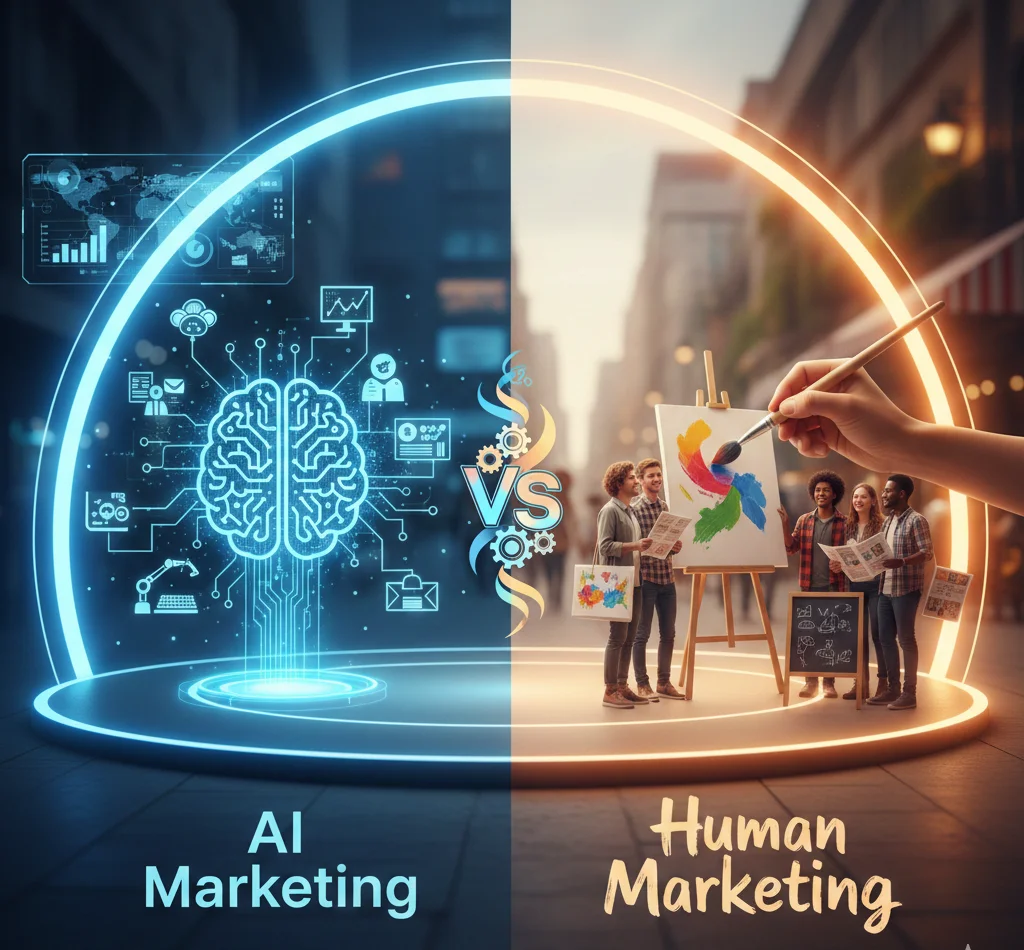
Moreover, the debate between AI and human marketing continues to shape how businesses approach growth in 2025. As digital marketing rapidly evolves, businesses face a new challenge: choosing between AI-driven marketing and human-powered marketing. In 2025, AI has become more accurate, affordable, and efficient than ever. But does that mean humans are no longer essential for real business growth? The answer is clear: AI and humans work best together, not against each other. AI vs Human Marketing has become one of the biggest discussions in 2025 as brands try to decide what truly drives growth. This blog breaks down the differences, strengths, and limitations of both and reveals the winning strategy for real growth in 2025.
What Is AI Marketing?
AI marketing uses machine learning, automation, and data analytics to perform marketing tasks like:
- Audience targeting
- Content generation
- Predictive analytics
- Email and ad automation
- Chatbots and customer support
- Performance optimization
Tools like ChatGPT, Jasper, HubSpot AI, Google Performance Max, and Meta AI Ads help businesses make data-based decisions instantly.
Why AI marketing is growing in 2025
- AI tools cost less than hiring multiple specialists
- They produce fast results
- They reduce human error
- They help businesses scale without increasing workload
AI is not replacing marketers it is replacing repetitive work.
What Is Human Marketing?
Human marketing refers to strategy, creativity, emotional intelligence, and brand positioning handled by real marketers.
Examples include:
- Branding and storytelling
- Emotional copywriting
- Market research
- Customer psychology
- Creative campaigns
- Building trust and community
Humans bring intuition something AI cannot replicate fully.
Why human marketing still matters
- People connect with real human stories
- Creativity cannot be automated
- Cultural understanding is human-driven
- Strategy requires experience, not data alone
- Customer relationships build trust
AI can execute, but humans guide the direction.
AI Marketing vs Human Marketing — Key Differences
1. Speed & Efficiency
AI wins.
AI completes tasks in seconds something that takes humans hours or days.
Batching content, analyzing data, and generating insights become effortless.
2. Creativity & Emotion
Humans win.
AI can mimic tone but cannot feel emotions or connect culturally.
Brands that rely only on AI risk sounding “robotic.”
3. Cost
AI wins.
AI tools cost less than hiring multiple marketers or agencies.
Great for startups and small businesses.
4. Strategy & Decision Making
Humans win.
AI cannot understand business goals, market reality, or brand personality.
Strategic thinking requires human judgment.
5. Scaling
AI wins.
You can produce unlimited content, ads, and reports using AI with minimal effort.
6. Authenticity & Trust
Humans win.
Customers trust brands that show human faces, stories, and experiences.
AI Marketing – Strengths and Limitations
AI Strengths
- Works 24/7
- Zero emotional bias
- Perfect for large data processing
- Automates repetitive tasks
- Fast A/B testing and performance prediction
- Helps optimize ROI
AI Limitations
- Lacks deep creativity
- Cannot understand cultural nuance
- May generate generic content
- Needs human supervision
- Cannot build real relationships
Additionally, AI tools make it easier for marketers to analyze data and automate repetitive tasks.
Human Marketing – Strengths and Limitations
Human Strengths
- Emotional storytelling
- Creative thinking
- Strategic analysis
- Personal communication
- Relationship-building
- Understanding trends and culture
Human Limitations
- Slower than AI
- Higher cost
- Limited productivity
- Prone to burnout
- Not always data-driven
Humans provide direction. AI provides execution. Furthermore, human creativity allows brands to connect emotionally with their audience.
Which Works Better for Real Business Growth in 2025?
The most effective approach for 2025 is a hybrid marketing model that combines the strengths of both.
Why hybrid marketing wins
In contrast to choosing only one method, combining AI and human marketing provides a more powerful approach.
- AI handles speed, data, automation
- Humans control strategy, creativity, and customer connections
- Businesses reduce costs while improving results
- Growth becomes predictable
- Messaging stays authentic
Real business example (scenario)
An eCommerce brand uses AI to analyze customer behavior, generate email sequences, and optimize ads.
Human marketers create brand storytelling, improve product messaging, and build community engagement.
Result:
Higher conversion rates + stronger brand trust + consistent revenue growth.
The Best AI + Human Hybrid Workflow
Use this combo to maximize growth:
AI Should Handle:
- Keyword research
- Competitor analysis
- Content outlines
- Email optimization
- Chatbots
- Ad targeting and automation
- Data analytics
Humans Should Handle:
- Final content editing
- Storytelling and tone
- Brand values and direction
- Social media engagement
- Creative campaigns
- Customer communication
This balance gives you speed + originality.
AI & Marketing Reports
HubSpot AI in Marketing Tools & Research
Google AI & Ads Insights
Conclusion
AI and human marketing work best when used together. AI brings speed, automation, and data accuracy, while humans add creativity, emotion, and strategic direction. AI and human marketing work best when combined. As a result, brands can achieve faster growth while maintaining authenticity and trust. In 2025, the businesses that grow the most will use AI to handle execution and humans to shape the overall approach. By combining both, you create a marketing system that is scalable, profitable, and built on trust.
Things You Have to Do in 2025
1. Use AI for Data, But Keep Humans for Strategy
AI should handle analytics, keyword research, customer behavior, and automation.
Humans should make the final decisions, set the direction, and refine messaging.
2. Create Human-Led Content With AI Support
Let AI generate outlines, ideas, and drafts.
Then add human creativity, storytelling, and emotional tone this is what makes content authentic.
3. Personalize Every Customer Touchpoint
AI tools help personalize:
- Email campaigns
- Website copy
- Product recommendations
- Retargeting ads
But humans craft the emotional hooks.
Personalization = higher conversions.
4. Use Automation to Scale Faster
Automate repetitive tasks like:
- Social media scheduling
- Reporting
- Lead nurturing
- Chat responses
This gives you more time to focus on creative strategy and business growth.
5. Build Trust Through Human Interaction
Even with AI everywhere, people trust brands that show:
- Faces
- Behind-the-scenes
- Real stories
- Honest communication
- Human customer support
AI creates efficiency.
Humans create trust.
FAQs for “AI vs Human Marketing”
1. Is AI marketing better than human marketing?
AI is better for speed, automation, and data analysis, while humans excel in creativity, strategy, and emotional storytelling. The best results come from combining both.
2. Will AI replace human marketers in 2025?
No. AI replaces repetitive tasks, not strategic or creative work. Human marketers will always be needed for brand voice, customer understanding, and decision-making.
3. What tasks should AI handle in marketing?
AI should manage data analytics, keyword research, content ideas, automation, ad optimization, and chatbots.
4. Why is human creativity still important?
Creativity builds emotional connection, trust, and brand identity something AI can’t fully replicate. Humans also understand cultural context better.
5. What is the best marketing approach for business growth?
A hybrid model:
AI for execution + humans for creativity and strategy = maximum growth.